President says Boeing is supporting preparations for a new national carrier as Ghana seeks to reclaim a place in international aviation. But the country’s troubled airline history raises questions about ownership, financing and long-term sustainability.
By Our Staff Reporter, Dallas USA
ACCRA, October 27, 2026 — President John Dramani Mahama has renewed his commitment to restoring Ghana’s national airline, saying work is progressing towards bringing back the carrier long associated with the country’s aviation history, Ghana Airways.
In a statement reported on October 26, 2026, the President indicated that he expected the airline to be operating before he leaves office in 2028. He also disclosed that the American aircraft manufacturer Boeing was assisting with preparations, including advice on aircraft selection and training for Ghanaian pilots and engineers.
“I can assure you that I don’t know what the name will be, but let me use Ghana Airways, which is the old airline. I can assure you that a lot of work is going on to bring back our national airline,” Mahama said.
He added: “Indeed, we are in partnership with Boeing. When I went to the UN General Assembly, Boeing Corporation came and saw us not only in the process of setting up but also to advise on aircraft, training of our engineers, and training of pilots.”
Explaining the expected role of the American company, the President said: “They want to work with us over the setup period of the airline, and so I think we have a good partner and work is proceeding, and I probably will soon announce the launch of the airline, and before I leave office we should have Ghana Airways back.”
The remarks, made while addressing officials in the United Kingdom, represent one of the administration’s clearest public assurances yet that Ghana intends to re-establish a national carrier.
However, the President’s use of the historic name should not be taken as confirmation that the defunct company itself has been legally restored. The precise name, ownership arrangement, operating partner, fleet, financing structure and launch date remain matters requiring formal clarification.
A National Airline Born Out Of Independence

Ghana Airways was established on July 4, 1958, barely sixteen months after Ghana attained independence from Britain. It commenced operations that month, with its first services based at Accra Airport,
The airline was created as a joint venture between the Ghanaian government, which held a 60 per cent stake, and British Overseas Airways Corporation (BOAC), the predecessor of British Airways, which held the remaining 40 per cent.
Its establishment reflected the ambitions of the government of Ghana’s first President, Dr Kwame Nkrumah, to build national institutions capable of supporting economic development, international diplomacy and closer links among African countries.
In the decades that followed, Ghana Airways became an important symbol of national identity. Its aircraft; branded with the red, yellow and green clors of the flag with a black star, carried passengers between Ghana and destinations across Africa, Europe and other parts of the world. The airline also supported cargo transport and helped connect Ghanaian businesspeople, students, diplomats and families with international destinations.

The carrier operated services to cities including London, Düsseldorf, Rome, Abidjan, Dakar, Lagos, Lomé and Johannesburg. It also operated direct services to New York at various stages of its history.
Its fleet changed over time and included aircraft such as the Bristol Britannia, Vickers VC10, Fokker F28, McDonnell Douglas DC-9 and the larger DC-10. These aircraft reflected the airline’s development from a young post-independence carrier into an operator serving both regional and long-haul markets.
By the late 1960s, the Ghanaian state had acquired BOAC’s interest, leaving Ghana Airways wholly government-owned.
For many Ghanaians, the airline came to represent more than a commercial transport company. It embodied the idea that an independent African country could operate its own international airline, maintain a skilled aviation workforce and participate directly in global commerce. It represented a source of national and continental pride.
How Ghana Airways Collapsed
The airline’s eventual demise was not caused by a single event. Its collapse followed years of financial losses, mounting debts, operational problems and weaknesses in management and financial oversight.
An International Monetary Fund report published in 2005 said Ghana Airways ceased operations in July 2004 after five consecutive years of losses. The report identified several contributors to its debt burden, including its failure to operate profitably, free or discounted tickets for government workers, purchases of substandard aircraft and the accumulation of expensive debts, sometimes without proper board approval.
The IMF identified inadequate financial oversight as a central problem.
The scale of the liabilities was substantial. The IMF estimated the airline’s debt at approximately US$172 million in 2005, while a later report by Graphic Business in July 2014 put the debt established during the liquidation process at about US$200 million.
In July 2004, the United States Department of Transportation barred Ghana Airways from operating in the American market, citing safety concerns and an expired operating license
The airline also experienced serious operational difficulties. In July 2004, the United States Department of Transportation barred Ghana Airways from operating in the American market, citing safety concerns and an expired operating license. The airline had been serving New York’s John F. Kennedy International Airport and Baltimore/Washington International Airport.
The Ghanaian government subsequently dissolved the airline’s board and established a task force to review and restructure its operations. The government assumed responsibility for its outstanding debts, which were reported at the time to be around US$160 million.
These interventions did not rescue the carrier. Ghana Airways entered liquidation, a process that proved lengthy and complicated.
Graphic Business reported in 2014 that the liquidation had not been fully concluded, with outstanding legal cases delaying closure. It reported that proceeds from the sale of assets had been used to pay secured creditors, while other liabilities remained to be addressed.
Ghana International Airlines: The First Successor
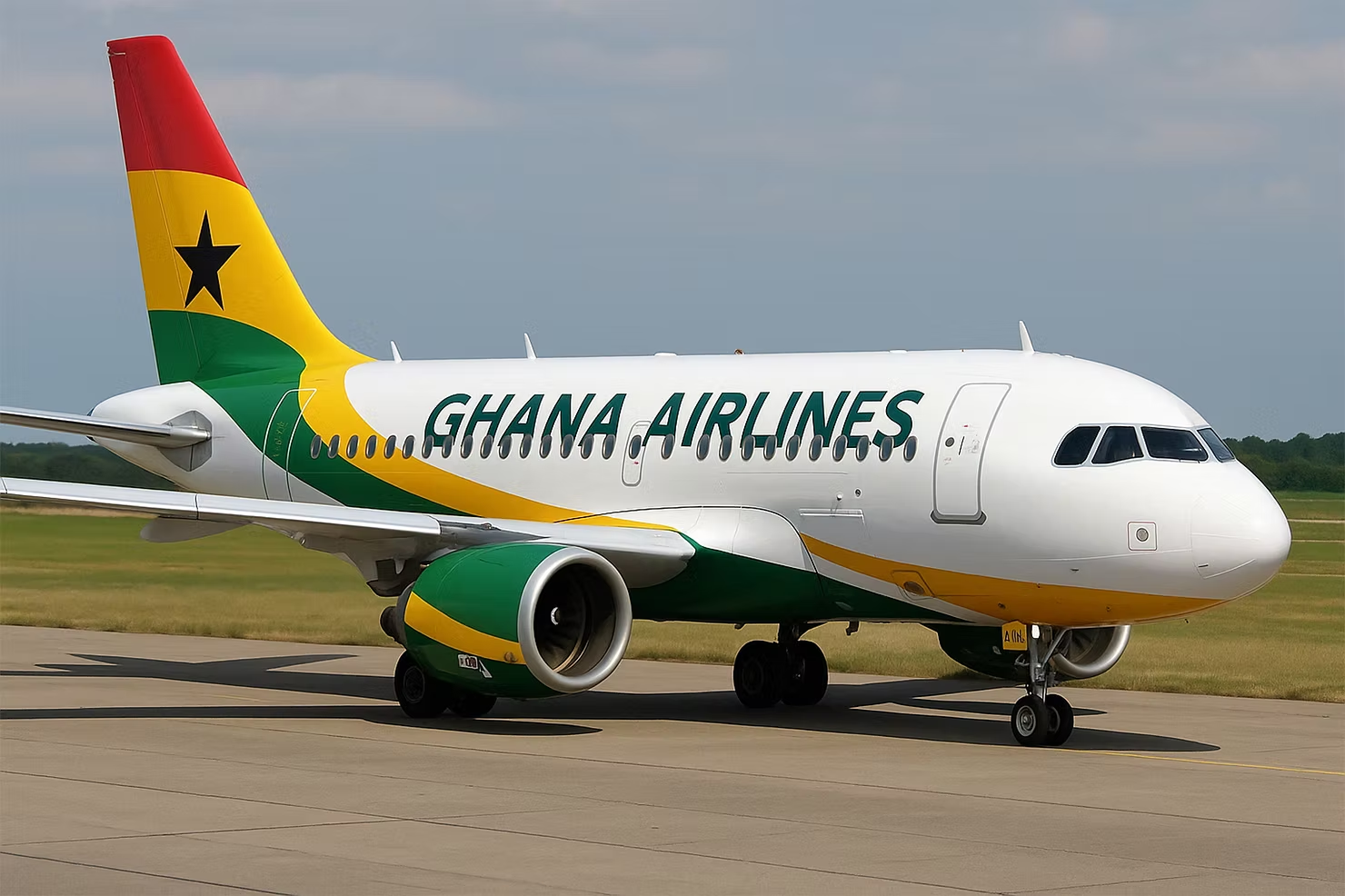
Following the collapse of Ghana Airways, the government pursued the establishment of a successor carrier through an arrangement involving private investors.
Ghana International Airlines (GIA) was established in 2005 and began operating scheduled, charter passenger and cargo services. The venture was intended to restore international connectivity under a new commercial structure.
However, the airline encountered financial and shareholder difficulties, including liquidity challenges and legal disputes. It ceased operations in 2010, leaving Ghana without a functioning national airline operating international services.
The experience reinforced a recurring challenge in Ghana’s efforts to restore a flag carrier: establishing an airline is one task; securing sufficient capital, a commercially viable route network, professional management and consistent operational discipline is another.
The failure of Ghana International Airlines meant that the country’s search for a sustainable national carrier continued long after the demise of its predecessor.
Repeated Attempts To Restore A National Carrier
Successive governments have explored different ways of bringing back a Ghanaian airline, with varying proposals involving international carriers, local investors and public-private partnerships.
In 2017, the government approved work towards establishing a home-based airline with private-sector participation. By 2018, the Ministry of Aviation was considering potential partners, including Air Mauritius, Abu Dhabi Aviation and Ethiopian Airlines.
In 2020, Ghana also signed a memorandum of understanding with EgyptAir as part of efforts to establish a new carrier. These initiatives did not result in a functioning national airline.
The previous administration subsequently pursued a proposal under which Ashanti Airlines would serve as the strategic operating partner for a new carrier branded GhanaAirlines. Ashanti Airlines was selected following a bidding process in 2022, but the project stalled. In May 2024, the Ghana Civil Aviation Authority confirmed that Ashanti Airlines’ certification had been suspended after the company failed to submit sufficient information.
In March 2025, President Mahama announced a renewed approach based on inviting competent, established partners to work with Ghana.
In his first State of the Nation address of his new term, he said: “We will reopen a transparent expression of interest to invite competent, established partners to work with us to establish a national airline.”
He argued that an efficiently run national carrier could help reduce fares on routes where foreign airlines enjoyed limited competition.
A Task Force And A New Roadmap
I am looking forward to receiving their presentation outlining the concrete roadmap for Ghana’s flag to fly proudly across Africa and in the global aviation space once again
In 2025, the Mahama administration established a technical task force to develop a sustainable business model and operational framework for a national carrier. Its work includes examining ownership arrangements, financing, fleet acquisition, regulatory compliance, potential strategic partners, staffing and route planning.
At a ceremony in April 2026 to mark the beginning of work on an interconnecting concourse between Terminals 2 and 3 at Kotoka International Airport, Mahama said he would meet the task force to receive its roadmap.
“I am meeting the taskforce I set up to work towards the re-establishment of our national airline this week, and I am looking forward to receiving their presentation outlining the concrete roadmap for Ghana’s flag to fly proudly across Africa and in the global aviation space once again,” he said.
The statement made clear that the administration wanted a practical plan covering the technical, financial and regulatory requirements for establishing the carrier.

Transport Minister Joseph Bukari Nikpe had earlier said in January 2026 that the proposed airline could begin operating within 12 months. He also indicated that the government did not intend to take a substantial equity stake, favouring a partnership designed to support private ownership and professional management.
That position is important because the latest presidential announcement does not, by itself, establish the final ownership structure. The government still needs to clarify whether the proposed carrier will be privately owned, jointly owned or organised under another arrangement.
Boeing’s Proposed Role
The President’s disclosure that Boeing is involved in the planning process has added a new dimension to the initiative.
According to President Mahama, Boeing’s contribution is expected to include advice on the selection of aircraft and the training of pilots and engineers. The President also suggested that the company would work with Ghana during the airline’s establishment period.
Such technical support could be valuable. Choosing the right aircraft requires decisions about passenger demand, route length, fuel efficiency, maintenance, crew training, spare parts, leasing costs and the availability of qualified personnel.
Nevertheless, it is important to distinguish technical advice and discussions from a completed commercial agreement.
As of October 27, 2026, the reports reviewed for this article do not establish that Ghana has placed a confirmed aircraft order with Boeing, concluded a financing agreement, selected a final operating partner or announced a firm inaugural-flight date.
Nor does Boeing’s reported involvement necessarily mean that it will own, operate or invest equity in the proposed airline. Those are separate arrangements that would require explicit confirmation.
The President’s announcement is therefore best understood as evidence of an ongoing establishment process, rather than confirmation that all the airline’s commercial and regulatory requirements have been settled.
Why Ghana Wants Its Own Airline
The case for restoring a national carrier extends beyond national pride. A viable airline could support trade, tourism, business travel, employment and the movement of people between Ghana and international markets. So far, this lucrative market is being milked by other carriers while Ghana, a leading destination in West Africa continues to act as a consuming partner.
1. Retaining More Aviation Revenue
Without a national carrier, much of the revenue generated by international passenger traffic flows to foreign airlines. A Ghanaian airline could retain part of that value domestically through its operations, payroll, maintenance, procurement, airport services and associated businesses.
However, owning an airline does not automatically guarantee that revenue will remain in Ghana. Its financial contribution would depend on profitability, local procurement, debt obligations and the extent to which its operations generate value within the country.
2. Supporting Trade And Tourism
Ghana is increasingly gaining recognition as one of the favored destinations in Africa for tourists; especailly from the United States and the Carribbean. A well-planned route network could improve access to Ghana for tourists, business travellers, investors and members of the diaspora. Direct connections to selected markets could also improve convenience for Ghanaian exporters and businesses that depend on international travel.
But routes must be selected on the basis of demand and commercial viability. Operating a direct flight simply because it is politically or symbolically desirable can expose an airline to sustained losses. It is believed President Mahama’s task force will consider this before rolling out its final plan.

3. Creating Skilled Employment
Last year, President Mahama announced plans to establish an aviation school and a Maintenance, Repair and Overhaul (MRO) facility at the Ho Airport in the Volta Region. Once this is accomplished, it will be a vital component to the President’s vision of resurrecting the proud national carrier with an attached establishment for training personnel to feed its labor demands
The establishment of a national carrier could create opportunities for pilots, cabin crew, aircraft engineers, dispatchers, safety specialists, customer-service personnel and other aviation professionals.
The President’s reference to pilot and engineering training suggests that skills development is part of the intended arrangement with Boeing. If structured properly, training could help build a long-term pool of Ghanaian aviation professionals.
Last year, President Mahama announced plans to establish an aviation school and a Maintenance, Repair and Overhaul (MRO) facility at the Ho Airport in the Volta Region. Once this is accomplished, it will be a vital component to the President’s vision of resurrecting the proud national carrier with an attached establishment for training personnel to feed its labor demands.
4. Strengthening Ghana’s Aviation-hub Ambitions
Ghana has invested in the Accra International Airport, including the development of Terminal 3 and ongoing efforts to improve connections between terminals. A national carrier could complement that infrastructure by adding routes, passengers and cargo traffic.
The ambition to make Ghana a regional aviation hub, however, would require more than a flag carrier. Efficient airport operations, competitive charges, reliable connections, effective immigration procedures, strong safety oversight and partnerships with other airlines would all be essential and these are some of the areas the President has tasked the team working on the roadmap to study.
Together with the aviation school and the MRO unit, Ghana’s dream of becoming the a true aviation on the African continent hub will be realized.
Lessons From Ghana Airways’ Failure
The history of Ghana Airways offers a clear warning: the return of the airline’s name will not, on its own, guarantee the return of its former role. It will however undoubtedly resurrect the pride of a country flying its flag on a proud carrier to many nations.
The IMF’s 2005 assessment identified financial indiscipline and weak oversight as major factors in the old carrier’s collapse. The experience also highlighted the risks of political interference in commercial decisions, excessive liabilities and obligations that do not generate sufficient revenue.
A successful new airline would need safeguards against these problems.
First, its management should be selected on professional and commercial grounds, with clear authority to make operational decisions without political interference. Secondly, the company should have transparent accounts, independent audits and effective board oversight. Thirdly, government-related travel arrangements and other public obligations should be paid for transparently rather than becoming hidden financial burdens.
Also, the airline would need a realistic capitalization plan that covers not only aircraft but also insurance, maintenance, fuel, airport charges, staff, marketing, training and working capital. Aircraft acquisition is only one part of the cost of operating an airline.

Finally, its route network must be commercially viable. A small, carefully selected network that can grow sustainably may be preferable to an ambitious international network that consumes capital faster than it generates revenue.
The question is not merely whether Ghana can launch an airline. It is whether the country can establish the governance and financial discipline required to keep it flying.
Details Soon To Be Announced By The Government
President Mahama’s latest statement has raised expectations, but several important details remain outstanding and these will soon be properly outlined once the task force has completed its work.
The government will soon explain:
- The name and legal structure: Will the new carrier use the Ghana Airways name, and will it be a new company rather than a revival of the liquidated entity?
- Ownership: Who will own the airline, and what role, if any, will the state play as a shareholder? What percentage will government hold if it decides to own shares in the ownership.
- Financing: How much capital will be required, where will it come from, and who will bear the financial risk?
- Aircraft: Which aircraft types are being considered, how many will be required at launch, and will they be leased or purchased?
- Routes: Which domestic, regional and long-haul routes will be served first?
- Operations: Which organization will hold the air operator certificate, and what arrangements will govern maintenance, safety, training and regulatory compliance?
- Launch timetable: What milestones must be completed before the first commercial flight? President Mahama has indicated that he expects the airline to be operational before he leaves office in 2028.
- Accountability: How will the public be informed about spending, contracts, performance and any government financial exposure?
These questions are central to determining whether the new initiative differs materially from earlier efforts that failed to progress from plans and partnership announcements to sustainable operations.
Conclusion: A Renewed Promise; A Revived Hope
President Mahama’s October 26 announcement marks another important chapter in Ghana’s long search for a national airline. His assurance that the carrier should be operating before he leaves office, together with the reported technical engagement with Boeing, signals renewed determination to move the project forward.
For a country whose first national airline was established in 1958 and whose last major carrier ceased operations in 2004, the prospect of a Ghanaian flag returning to international routes carries considerable cultural, historical and economic significance.
But the central test will be execution. Ghana Airways’ collapse showed the consequences of weak financial controls and unsustainable operations; the subsequent failure of Ghana International Airlines demonstrated that a successor could also struggle to survive.
A new carrier must therefore be built around sound commercial decisions, professional management, adequate capital, transparent ownership and credible oversight. If these conditions are met, the airline could contribute to trade, tourism, employment and international connectivity. If they are neglected, the country risks repeating a costly cycle of announcements, investment and collapse.
The President has made his commitment clear. The next measure of progress will be the publication of a concrete implementation plan, the disclosure of financing and ownership arrangements, and the completion of the regulatory and operational steps needed to put the first aircraft into service.
For Ghanaians, the real milestone will not be the announcement of Ghana Airways’ return, but the day a sustainably financed, professionally managed Ghanaian carrier begins flying—and continues to fly.